Choosing between a self-hosted Large Language Model (LLM) and a cloud-based AI API is an important infrastructure decision for businesses developing AI-powered applications. Hosted APIs from providers such as OpenAI and Anthropic make it easy to integrate advanced language models without managing hardware. However, as application usage increases, recurring API charges, rate limits, data governance requirements and infrastructure dependencies can become significant considerations.
Self-hosting an open-source LLM on a dedicated GPU server offers another approach. Instead of paying a provider for every million input and output tokens, businesses can deploy compatible models on their own infrastructure and manage inference workloads directly.
However, owning GPU infrastructure is not automatically cheaper. The financial benefits depend on model selection, GPU utilisation, token throughput, workload consistency and operational costs.
So, when does a self-hosted LLM actually become more cost-effective than an API? This guide explains the technical differences, break-even calculations, GPU requirements and business scenarios that can help you make the right decision.
Self-Hosted LLM vs API: Understanding the Difference
Before comparing costs, it is important to understand how each deployment approach works.
What Is a Hosted LLM API?
A hosted LLM API allows developers to access an AI model through an application programming interface without deploying or maintaining the underlying infrastructure.
When an application sends a prompt, the API provider processes the request using its own computing infrastructure and returns the generated response.
For example, developers can integrate services from OpenAI or Anthropic into applications using API requests. The provider manages GPU infrastructure, model deployment, scaling and much of the underlying maintenance.
Key characteristics of hosted LLM APIs include:
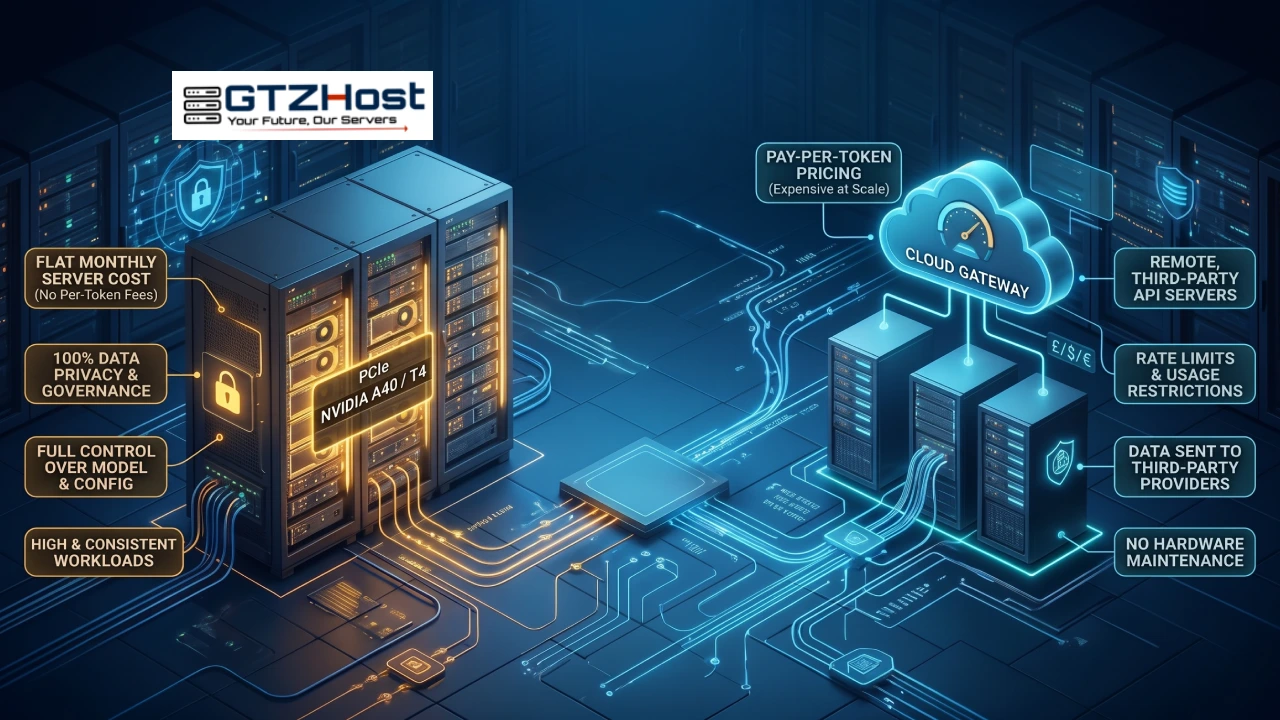
Pay-per-token pricing based on input and output usage.
No requirement to purchase or maintain GPU hardware.
Access to provider-managed models and updates.
Simplified application integration through API endpoints.
Provider-defined rate limits and usage restrictions.
Data processing subject to the provider's security, privacy and retention policies.
This approach is particularly useful for startups, developers testing AI applications and businesses with unpredictable or relatively low inference workloads.
What Is a Self-Hosted LLM?
A self-hosted LLM runs on infrastructure controlled by the business rather than relying entirely on an external model provider.
Businesses can deploy compatible open-weight models such as Llama and Mistral on dedicated GPU servers using inference software such as vLLM, Ollama or Hugging Face Transformers.
In this architecture, the application sends requests to an inference server running on the business's own infrastructure.
The organisation manages the model files, GPU resources, inference configuration, application integration and security controls.
Key characteristics of self-hosted LLM deployment include:
Predictable underlying server rental or ownership costs.
Direct control over model selection and deployment.
Greater control over data processing and storage.
Customisable inference configurations.
No third-party API token charges for locally generated tokens.
Responsibility for infrastructure maintenance, scaling and optimisation.
Unlike a hosted API, self-hosting requires technical expertise and sufficient GPU resources to handle the intended workload.
Hosted LLM API vs Self-Hosted LLM: Which Is Better?
Neither deployment model is universally better. The right choice depends on your application requirements, workload characteristics and available infrastructure resources.
1. Pricing and Cost Structure
Hosted APIs generally use usage-based pricing. Businesses pay according to the number of input and output tokens processed by the selected model.
This makes costs relatively easy to manage at low usage levels. However, applications generating millions of responses can accumulate substantial recurring charges.
Self-hosted LLMs use a different pricing structure. Instead of paying per token, businesses pay for the infrastructure required to run their models.
A dedicated GPU server introduces a relatively fixed monthly infrastructure expense, regardless of whether the GPU processes a small or large number of requests. However, this does not mean inference capacity is unlimited.
GPU utilisation, electricity or hosting charges, storage, bandwidth, monitoring and maintenance still contribute to the total cost of operating the environment.
2. Data Privacy and Security
Data governance is another important consideration when choosing between hosted APIs and self-hosted infrastructure.
When using an external API, application data must be transmitted to the provider for processing. The provider's contractual terms, retention policies, security controls and data-processing arrangements determine how that information is handled.
With a self-hosted LLM, organisations have greater control over where model inference happens and how application data is processed.
For example, a business can deploy an internal inference endpoint within a private network, restrict external access and apply its own authentication, logging and retention policies.
This approach can be valuable for:
Healthcare applications handling sensitive records.
Financial applications processing confidential information.
Enterprise knowledge-management platforms.
Internal AI assistants accessing proprietary documents.
Businesses with strict data residency requirements.
However, self-hosting does not automatically guarantee security or regulatory compliance. Proper network isolation, access controls, encryption, patch management and monitoring remain essential.
3. Performance and Scalability
Hosted APIs provide access to infrastructure managed by the provider. This removes much of the complexity associated with GPU provisioning and model deployment.
However, applications remain subject to provider-defined rate limits, quotas, service availability and network latency.
A dedicated GPU server provides direct control over the available computing resources. Developers can optimise model inference, configure batching, adjust concurrency and allocate GPU resources according to application requirements.
The limitation is hardware capacity.
A GPU can only process a finite number of requests at a given time. When incoming requests exceed available inference capacity, response latency increases and requests may need to be queued or rejected.
Therefore, self-hosting removes dependence on third-party API quotas but does not eliminate performance bottlenecks.
When Does a Dedicated GPU Server Become Cheaper Than an API?
The most important question is not simply how many tokens your application generates each month. It is how much you currently spend on API inference compared with the total cost of running equivalent workloads on dedicated GPU infrastructure.
The break-even point varies significantly depending on the selected model, API pricing, hardware configuration and actual inference performance.
Understanding API Token Costs
Most commercial LLM APIs distinguish between input and output tokens.
Input tokens include the prompt, conversation history and other context supplied to the model. Output tokens represent the content generated by the model.
These two categories can have different prices.
For example, consider an application that processes:
100 million input tokens per month.
25 million output tokens per month.
The monthly API cost can be calculated using:
Monthly API Cost = (Input Tokens ÷ 1,000,000 × Input Price) + (Output Tokens ÷ 1,000,000 × Output Price)
The calculation should use the actual published pricing for the selected model, including any applicable caching discounts or additional charges.
This distinction matters because two applications generating the same total number of tokens can have very different API bills depending on their input-to-output ratios.
Calculating the Self-Hosted Break-Even Point
For self-hosted inference, the monthly cost includes more than the GPU server rental.
You should account for:
Dedicated GPU server rental or hardware depreciation.
Additional storage requirements.
Network and bandwidth charges, where applicable.
Infrastructure monitoring and maintenance.
Engineering time for deployment and optimisation.
Backup, security and operational requirements.
A practical comparison is:
Self-Hosted Monthly Cost = GPU Infrastructure + Storage + Networking + Operations + Engineering Costs
The potential monthly savings can then be calculated as:
Monthly Savings = Equivalent API Cost − Total Self-Hosted Cost
If the result is positive, self-hosting may provide a financial advantage, provided that both solutions deliver comparable model quality, throughput and reliability.
An Illustrative Break-Even Example
Consider a business currently spending $800 per month on a hosted LLM API.
It is evaluating a dedicated GPU server with the following hypothetical monthly operating costs:
GPU server: $450.
Additional infrastructure: $50.
Operations and maintenance allocation: $100.
The estimated self-hosted operating cost is $600 per month.
If the self-hosted environment can handle the same workload with comparable response quality and acceptable latency, the potential monthly saving would be $200.
However, if the GPU server cannot handle the required request volume or needs additional hardware, the calculation changes.
This is why token volume alone should never determine a hosting decision.
The real break-even point is reached when the total cost of operating your self-hosted inference environment becomes lower than the cost of purchasing equivalent API inference capacity.
Three Workload Scenarios to Consider
Low-volume AI applications
If your application processes relatively few requests, a hosted API is generally the more practical option.
You avoid GPU rental expenses, infrastructure administration and the complexity of maintaining an inference environment.
Consistent, medium-to-high inference workloads
Businesses with predictable AI usage should start evaluating dedicated GPU infrastructure.
If monthly API spending continues increasing, comparing the cost of equivalent self-hosted inference becomes worthwhile.
High-volume AI applications
Applications processing large volumes of repeated inference requests may benefit significantly from dedicated GPU infrastructure.
Examples include customer-support automation, document processing, internal AI assistants and AI-powered content platforms.
However, the financial benefit depends on maintaining sufficient GPU utilisation and ensuring that the hardware can meet the application's performance requirements.
5 Reasons to Consider a Dedicated GPU Server for LLM Hosting
Cost savings are only one reason businesses consider moving AI inference workloads to dedicated hardware.
1. Greater Control Over Data Processing
Self-hosted LLM deployment allows organisations to control where inference takes place and how application data is handled.
Sensitive information can be processed within a private infrastructure environment without sending every prompt to an external model API.
This is particularly useful for businesses building internal AI assistants, private knowledge bases and applications that process confidential company information.
2. Control Over Inference Configuration
Hosted API users generally work within the provider's available models, parameters and service restrictions.
With self-hosted deployment, developers can select compatible open-weight models, configure inference engines and optimise generation settings.
Depending on the model and serving software, they can also configure:
Quantisation to reduce memory requirements.
Continuous batching to improve GPU utilisation.
KV cache allocation for concurrent requests.
Maximum context length.
Sampling parameters and generation limits.
Model-specific optimisation techniques.
These capabilities provide greater flexibility when building specialised AI applications.
3. Reduced Dependency on External API Quotas
Commercial API providers apply usage limits to manage their infrastructure and service availability.
These can include requests per minute, tokens per minute and other account-level restrictions.
Running an inference endpoint on a dedicated GPU server gives businesses greater control over request handling and capacity planning.
There are still hardware limitations, queue management requirements and potential network bottlenecks, but developers are no longer dependent on a third-party provider's token quota for locally generated responses.
4. More Predictable Infrastructure Expenses
Usage-based API billing can become difficult to forecast when application traffic changes unexpectedly.
A dedicated GPU server offers a more predictable underlying infrastructure expense.
For applications with consistent and sufficiently high workloads, this can make financial planning easier.
Nevertheless, businesses should account for additional infrastructure and operational expenses rather than assuming that server rental represents the entire cost of self-hosting.
5. Greater Infrastructure Independence
Self-hosting provides control over model deployment and the inference environment.
Businesses can update models, change inference engines, customise configurations and integrate AI workloads with their existing applications.
This is especially useful for development teams building long-term AI products that require greater control over their infrastructure.
Choosing the Right GPU for Self-Hosted LLM Inference
Not every dedicated server is suitable for running Large Language Models.
The most important hardware consideration is GPU memory, commonly referred to as Video Random Access Memory (VRAM).
LLM inference requires GPU memory to accommodate model weights, the KV cache and additional runtime allocations.
The amount of VRAM required depends on model size, numerical precision, quantisation, context length and the number of concurrent requests.
NVIDIA Tesla T4: Efficient AI Inference
The NVIDIA Tesla T4 is an inference-focused GPU featuring 16GB of GDDR6 memory.
It supports NVIDIA Tensor Cores and is suitable for selected machine-learning workloads, smaller language models and quantised LLM deployments.
Its relatively modest VRAM capacity makes model selection particularly important.
A T4 can be a practical option for experimentation, smaller inference workloads and applications that do not require large model architectures or extensive context windows.
However, it should not be treated as a universal solution for large LLM deployments.
NVIDIA A40: Higher VRAM Capacity for Demanding Workloads
The NVIDIA A40 provides 48GB of GDDR6 memory with ECC support.
Its larger memory capacity makes it more suitable for deploying larger models, handling more demanding inference configurations and supporting workloads that require additional GPU memory.
Depending on the selected model, precision and serving configuration, the A40 can support inference workloads that would exceed the memory capacity of a T4.
It is also designed for professional visual computing and other GPU-intensive workloads.
For businesses evaluating self-hosted LLM infrastructure, the additional VRAM provides greater flexibility in model selection and deployment.
Why GPU VRAM Matters More Than You Think
A common mistake when choosing AI hardware is focusing exclusively on GPU processing power.
Although compute performance is important, a model must first fit within the available GPU memory or use a suitable multi-GPU or offloading configuration.
For example, an unquantised 7-billion-parameter model using 16-bit weights requires approximately 14GB of memory just for its model weights.
This does not include the KV cache, runtime overhead or other allocations.
Quantisation can reduce model memory requirements, but it may introduce trade-offs in model quality and performance.
Similarly, increasing the context length or supporting more simultaneous users can increase memory consumption.
Therefore, GPU selection should be based on the complete inference workload rather than model parameter count alone.
How to Deploy an Open-Source LLM on a Dedicated GPU Server
Once the hardware has been selected, deploying a self-hosted LLM involves several infrastructure and software configuration steps.
Step 1: Select a Compatible Open-Weight Model
Choose a model based on the application's requirements, including reasoning ability, language support, context length and expected inference performance.
Popular model families include Llama and Mistral.
Check the model licence and deployment requirements before using it commercially.
Step 2: Prepare the GPU Server Environment
Install a compatible operating system, NVIDIA GPU drivers and the appropriate CUDA components required by your selected inference stack.
Verify that the GPU is detected correctly before proceeding.
For NVIDIA GPUs, the following command can help confirm hardware visibility:
nvidia-smiThis displays information such as GPU utilisation, memory consumption, temperature and running processes.
Step 3: Install an LLM Inference Engine
Choose an inference platform that matches your deployment requirements.
Common options include:
Ollama: Provides a straightforward approach to downloading, running and managing supported models.
vLLM: Designed for efficient LLM serving, continuous batching and higher-throughput inference workloads.
Hugging Face Transformers: Offers extensive flexibility for model loading, experimentation and custom inference pipelines.
The right choice depends on the model architecture, GPU configuration and application requirements.
Step 4: Configure the Inference Endpoint
Configure the inference service to accept requests from your application.
For production environments, implement authentication, access restrictions, request validation and secure network communication.
Avoid exposing model-management interfaces or unauthenticated inference endpoints directly to the public internet.
Step 5: Benchmark and Optimise Performance
Before launching the application, test the model under realistic workloads.
Measure:
Time to first token (TTFT).
Output tokens per second.
Total request latency.
GPU memory utilisation.
Concurrent request capacity.
Request queueing and throughput.
Use these measurements to determine whether the server can support the expected production workload.
A model that performs well during a single-user test may behave very differently when multiple users submit requests simultaneously.
When Should You Keep Using an LLM API Instead?
Self-hosting is not always the right decision.
In some cases, continuing with a hosted API is more economical and technically practical.
Consider keeping your existing API integration when:
Your application has low or unpredictable usage: Paying for actual consumption can be cheaper than maintaining a GPU server that remains underutilised.
You depend on proprietary models: If your application requires specific capabilities from a commercial model that are unavailable in an appropriate open-weight alternative, self-hosting may not be a suitable replacement.
Your team lacks infrastructure expertise: Managing GPU drivers, inference engines, security and performance optimisation requires technical knowledge.
You need rapid development: APIs allow developers to integrate AI capabilities without spending time deploying and maintaining model-serving infrastructure.
You require elastic capacity: Applications with highly variable traffic may benefit from provider-managed scaling rather than maintaining enough dedicated hardware for occasional traffic peaks.
There is also a third option: a hybrid AI architecture.
Businesses can run frequently used or privacy-sensitive workloads on dedicated GPU infrastructure while using external APIs for specialised tasks, overflow traffic or workloads requiring different model capabilities.
This approach can balance infrastructure control, performance and cost.
Why Choose GTZHost for Dedicated GPU Server Infrastructure?
Deploying a self-hosted LLM requires more than selecting an open-source model. The underlying infrastructure must provide sufficient GPU memory, processing capacity, reliable networking and the flexibility to support production inference workloads.
GTZHost provides dedicated GPU server infrastructure designed for demanding computing requirements, including AI inference, machine learning and GPU-accelerated applications.
NVIDIA GPU Hardware Options
GTZHost offers GPU server configurations featuring NVIDIA Tesla T4 and NVIDIA A40 hardware.
These GPUs address different workload requirements, allowing businesses to evaluate infrastructure based on model size, VRAM capacity and expected inference performance.
The Tesla T4 provides 16GB of GDDR6 memory for compatible inference workloads, while the A40 offers 48GB of GDDR6 memory for more demanding GPU applications.
Dedicated Bare-Metal Infrastructure
Dedicated GPU servers provide direct access to allocated physical hardware rather than relying on shared virtual GPU resources.
This gives developers greater control over their operating environment, GPU utilisation and inference configuration.
GTZHost infrastructure includes enterprise server platforms such as Dell PowerEdge R740XD and HPE ProLiant DL385, subject to configuration and GPU compatibility.
High-Bandwidth Network Connectivity
Network performance also matters when deploying AI applications.
GTZHost offers configurations with network connectivity of up to 40Gbps unmetered bandwidth, subject to server availability and the selected plan.
Higher-bandwidth connectivity can support applications involving large model downloads, remote access, distributed workloads and data-intensive AI pipelines.
Actual application performance will also depend on network latency, routing, storage performance and the capacity of connected systems.
Infrastructure That Can Grow With Your AI Workloads
As your application develops, its infrastructure requirements may change.
You may need additional GPU memory, more inference capacity, improved networking or a different model deployment architecture.
Selecting a dedicated infrastructure provider that can support your evolving requirements makes long-term capacity planning easier.
Explore the available GTZHost GPU server configurations to identify a suitable environment for your AI workloads.
Final Verdict: Is a Dedicated GPU Server Worth It for LLM Hosting?
The choice between a self-hosted LLM and a hosted API ultimately comes down to workload economics, technical requirements and infrastructure control.
For startups and applications with low inference usage, hosted APIs remain an efficient way to access advanced language models without managing hardware.
However, businesses processing consistent volumes of AI requests should evaluate the economics of running compatible open-weight models on dedicated GPU infrastructure.
Self-hosting can provide greater control over data processing, model configuration, inference capacity and recurring infrastructure expenses. The financial benefits become more attractive when GPU resources are used efficiently and the total operating cost is lower than the equivalent API expenditure.
Before making the switch, calculate your actual input and output token costs, benchmark the selected model on the proposed GPU hardware and account for all infrastructure and operational expenses.
Ready to take greater control of your AI infrastructure?
Explore GTZHost Dedicated GPU Servers and find the right hardware foundation for your self-hosted LLM, AI inference and machine-learning workloads.
Build your AI infrastructure around your requirements, not someone else's API limits.