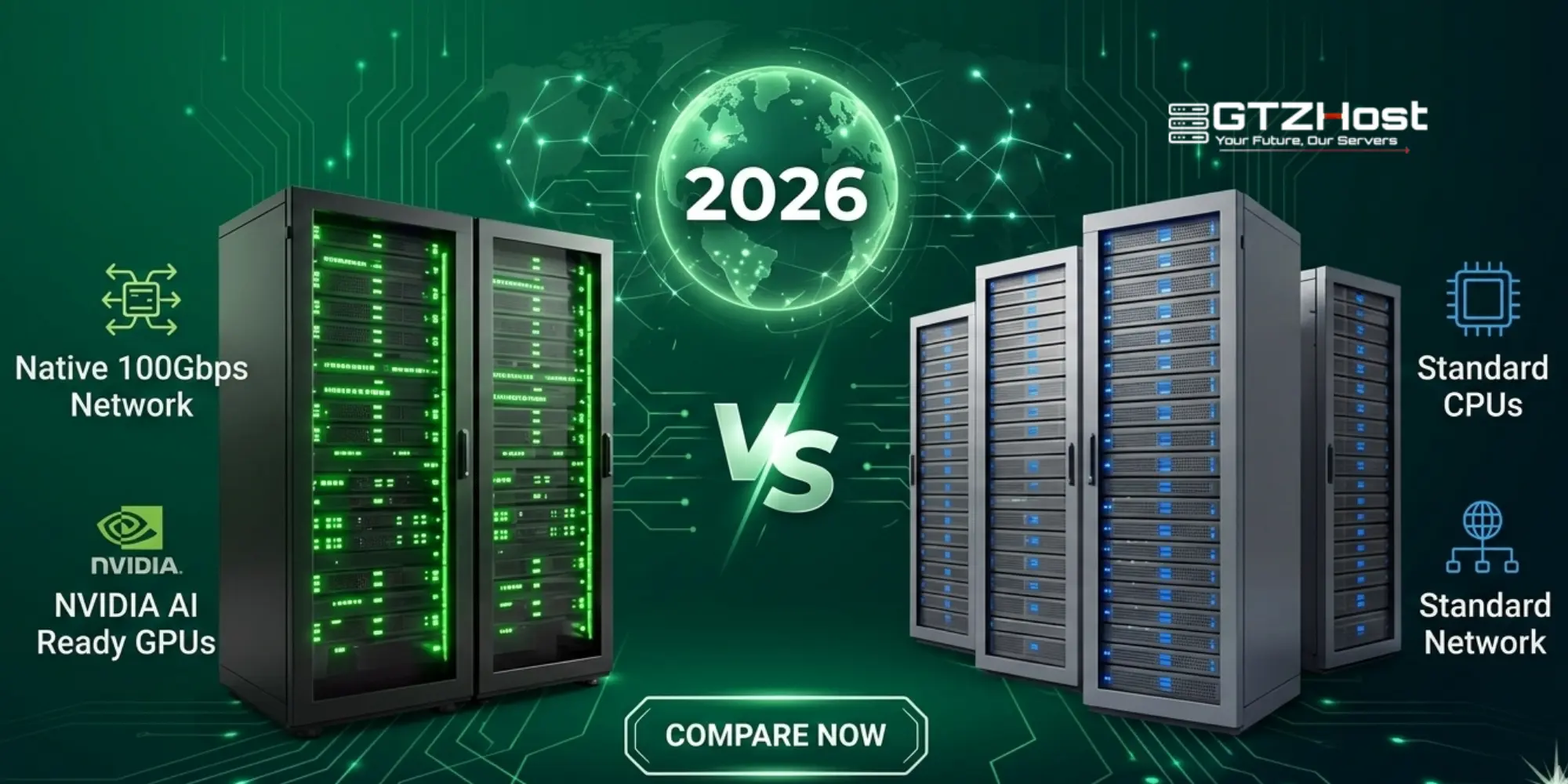
Three years ago, a "good" dedicated server meant a fast CPU, ample RAM, and a 1Gbps uplink. That was enough for most web applications, e-commerce stores, and basic game servers. 2026 is a completely different story.
Today, businesses are deploying their own AI inference models on dedicated hardware to escape expensive cloud APIs. Live streaming platforms are pushing 4K and 8K content that demands sustained multi-gigabit throughput. Online game servers face volumetric DDoS attacks that make basic "protection" marketing claims meaningless.
Most hosting comparisons still evaluate providers based on CPU core count and disk size. This guide is different. We evaluated five major providers on the metrics that actually matter for 2026: network uplink capacity, DDoS scrubbing power, GPU availability, global reach, and support flexibility.
Why 2026 Demands More From Your Dedicated Server
Before comparing providers, it's important to understand the three workload shifts that redefine "good infrastructure" this year:
AI Inference at the Edge: Standard CPUs simply cannot handle fine-tuned models at scale. This requires dedicated GPU-capable servers with high memory bandwidth.
Live Streaming Has Gone 4K/8K: A single high-quality 4K broadcast stream consumes 25–50 Mbps. Platforms running concurrent streams need sustained multi-gigabit throughput.
Gaming Servers Are Under Siege: With DDoS attack sizes regularly crossing 150Gbps, a provider without serious, transparent scrubbing capacity leaves your infrastructure vulnerable.
The 2026 Market Comparison: Who Offers What?
Price is a starting point, not the full picture. Here is how the top providers actually stack up against each other.
| Feature | GTZHost 🏆 | OVHcloud | Leaseweb | Vultr (Bare Metal) | Hetzner |
|---|---|---|---|---|---|
| Max Uplink Speed | Up to 100Gbps (Select Plans) | 1Gbps / Premium 10Gbps+ | 10Gbps (Upgradeable) | 10Gbps | 1Gbps / 10Gbps |
| Anti-DDoS Capacity | 250Gbps Included | Multi-Tbps (VAC) | ~800Gbps (Paid Add-on) | ~20Gbps | Not Disclosed |
| GPU / AI Servers | NVIDIA GPUs Available | Limited (OVH AI) | Limited | Cloud GPU Only | Not Available |
| Global Locations | 250+ (6 Continents) | ~30 Locations | ~20 Locations | 32 Locations | 3 Locations (EU/US) |
| Support Model | Managed & Unmanaged | Unmanaged by Default | Managed Available | Self-Managed Only | Unmanaged Only |
| Starting Price | From $40.00/mo | From ~$55/mo | From ~$60/mo | From ~$120/mo | From ~$45/mo |
1. GTZHost — The "Sweet Spot" for AI, Gaming & Global Performance
Best For: AI inference workloads, game server operators, and global SaaS businesses that need high network performance with the flexibility of support.
GTZHost earns the top position because it actively bridges the gap between affordable pricing and enterprise-grade network capabilities. Instead of forcing you to choose between cheap, unsupported hardware or overpriced enterprise contracts, GTZHost offers the middle ground.
Massive Network Headroom: While most providers cap standard servers at 1Gbps, GTZHost offers configurations capable of up to 100Gbps unmetered uplinks. For streaming and AI APIs, this removes the biggest bottleneck.
250Gbps Anti-DDoS Standard: Instead of hiding DDoS capacity behind a paid enterprise add-on, GTZHost includes 250Gbps of scrubbing capacity on standard setups—a game-changer for multiplayer server hosts.
Support on Your Terms: Need a SysAdmin team to handle OS hardening? Choose Fully Managed. Want root access and zero interference? Go Unmanaged.
250+ Global Locations: Deploy close to your users anywhere from North America to Southeast Asia, without massive geographical price hikes.
2. OVHcloud — Raw Scale for Independent SysAdmins
Best For: Experienced developers who manage massive infrastructure and rarely need provider support.
OVHcloud is a global giant. Their proprietary water-cooling and massive data centers allow for incredible hardware density. Their proprietary VAC technology offers Multi-Tbps DDoS protection, which is world-class.
The Catch: OVH operates on volume. Their standard support tier is minimal, meaning you are largely on your own. To get rapid engineering support, you must purchase expensive Business or Enterprise support tiers.
3. Leaseweb — Enterprise Power (For Enterprise Budgets)
Best For: Large corporations with substantial infrastructure budgets requiring strict SLAs and dedicated account management.
Leaseweb offers a highly reliable network backbone and up to 800Gbps of DDoS protection.
The Catch: Their premium features come with a premium price tag. High-capacity DDoS scrubbing is a paid add-on, and their billing structure heavily favors large-scale, long-term bulk commitments rather than agile startups.
4. Vultr — API-First Bare Metal
Best For: DevOps teams who want to provision dedicated hardware using Terraform or Pulumi.
Vultr brings cloud-like provisioning to dedicated servers. They have a clean API and deploy bare metal quickly.
The Catch: All servers are strictly self-managed, and starting prices for dedicated hardware are noticeably higher (~$120/mo). Their network uplink and DDoS protection on bare metal max out much lower than GTZHost or OVH, limiting high-end gaming use cases.
5. Hetzner — The European Budget King
Best For: Small projects and developers whose entire user base is in Germany or Finland.
Hetzner offers arguably the best pure CPU-to-price ratio in Europe, utilizing consumer-grade hardware (like AMD Ryzen) at incredibly low prices.
The Catch: They are heavily localized. Outside of the EU and a single US location, they have no footprint. They also enforce extremely strict identity verification (KYC), offer zero managed support, and do not provide dedicated GPU servers for modern AI workloads.
Conclusion: Match Your Workload to Your Provider
Every workload has a different bottleneck. If you have an unlimited enterprise budget, Leaseweb is a safe bet. If your users are exclusively in Germany and you need the cheapest CPU available, Hetzner is a great choice.
But if you are building for 2026 and need GPU availability, high-capacity DDoS protection, global reach, and the flexibility to choose between Managed or Unmanaged support—all starting from sensible price points—GTZHost is the clear winner. Don't let legacy server limits throttle your next big project.
Disclaimer: Pricing, hardware specifications, and network capacities mentioned in this article are based on publicly available data as of early 2026. High-end features like 100Gbps uplinks and GPU availability apply to specific enterprise configurations.
Frequently Asked Questions (FAQ)
Do I need a GPU server for AI in 2026, or will a high-core CPU work?
It depends on your workload. For AI inference on smaller models (under 7B parameters), a high-core-count AMD EPYC or Intel Xeon with fast NVMe storage can handle reasonable throughput. For training, fine-tuning, or running larger inference workloads at scale, an NVIDIA GPU is not optional — it is a requirement. GTZHost offers both CPU-optimised and GPU-ready dedicated server configurations. Contact our team to discuss which hardware matches your model size and request volume.
What does "250Gbps Anti-DDoS" mean in practice for a game server?
It means our scrubbing infrastructure can absorb and filter 250 gigabits per second of malicious traffic before it ever reaches your server. A volumetric DDoS attack sending 200Gbps of UDP flood traffic would be fully absorbed by our mitigation layer — your server only sees clean traffic. The average large-scale gaming DDoS attack in 2024–2025 ranged between 100Gbps and 180Gbps. Our 250Gbps capacity covers the majority of real-world attack scenarios without extra cost or configuration on your end.
Is the $40.00/mo price available in all 250+ locations?
We believe in complete transparency on this point. The $40/mo starting price applies to our standard dedicated server configurations in major European and North American hubs, where bandwidth transit costs are lowest. For locations in Africa, Southeast Asia, or South America, infrastructure costs naturally vary — and our pricing reflects that honestly. The $40/mo figure represents a real configuration that real customers order, not a bait-and-switch entry point that does not exist in our actual inventory.
Can I switch between Managed and Unmanaged support after ordering?
Yes. GTZHost allows you to choose your support tier at the time of ordering, and you can request a change if your needs evolve. For example, if you initially configure your own OS environment but later want our team to handle ongoing maintenance, security patching, and monitoring — we can discuss the transition process and any configuration considerations before making the switch.
What network backbone does GTZHost use?
All GTZHost dedicated servers operate on a Cisco and Juniper-powered network connected to top-tier upstream providers including Level3, Highwinds, and Cogent. This multi-provider redundancy means that even if a single upstream carrier experiences issues, your server traffic is automatically rerouted — maintaining uptime and performance. Our 99.99% network SLA is backed by this redundant architecture.