Category: Dedicated Servers
Quick Answer
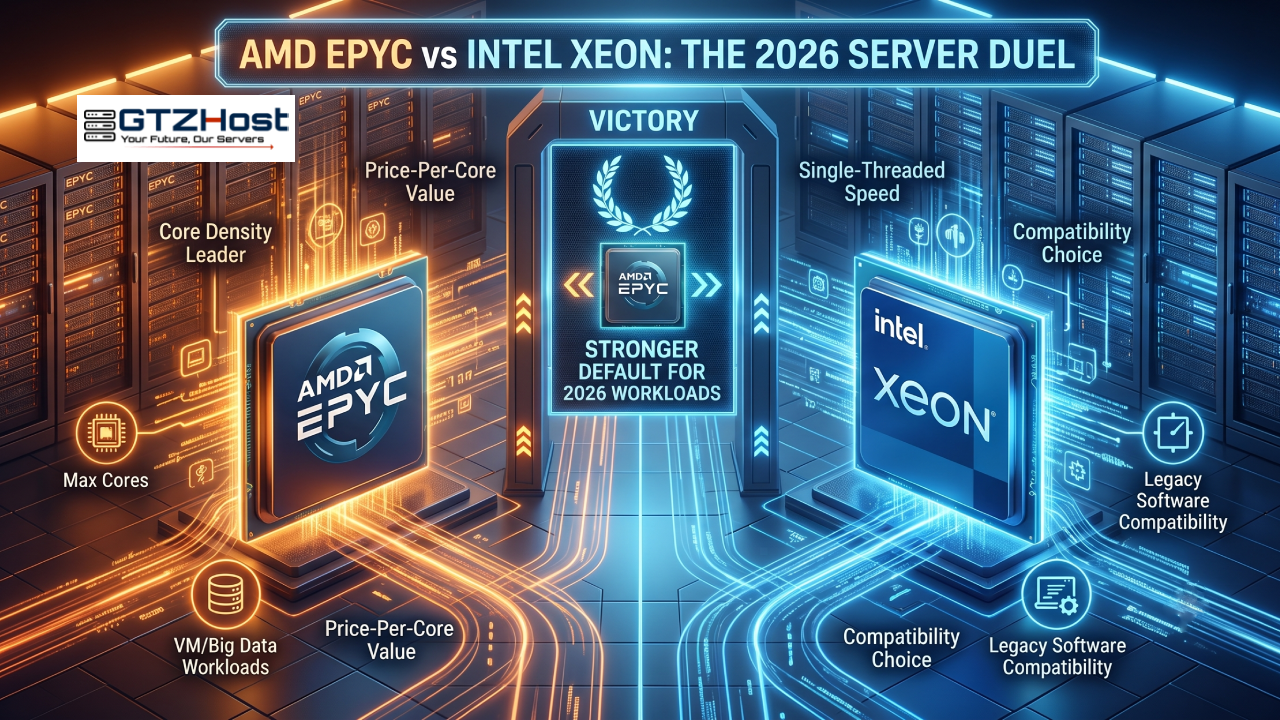
AMD EPYC dedicated servers win on core density, memory bandwidth, and price-per-core — making them the better choice for virtualization, big data, and database workloads. Intel Xeon dedicated servers still lead in single-threaded clock speed and software compatibility for legacy enterprise applications that are licensed or optimized specifically for Intel architecture. For most 2026 workloads (AI/ML, containers, high-traffic databases), AMD EPYC is the stronger default.
Introduction
Choosing between an AMD EPYC dedicated server and an Intel Xeon dedicated server is one of the most consequential infrastructure decisions a business will make in 2026. The decision affects virtualization density, database throughput, hosting costs, and long-term scalability. This guide breaks down the real architectural differences between AMD EPYC and Intel Xeon processors, and shows exactly which workloads perform better on each platform when deployed as bare-metal dedicated hardware.
AMD EPYC: Built for Core Density and Virtualization
AMD's EPYC server processor line is engineered around massive multi-core parallelism. GTZHost's AMD dedicated servers scale from a 64-core EPYC 7702 configuration up to an industry-leading 128-physical-core EPYC 9754, giving businesses the raw parallel computing power required for container clusters, hypervisors, and multi-tenant workloads.
Three architectural advantages define the EPYC platform:
Core count and threading: Up to 128 physical cores per socket, ideal for hypervisors like Proxmox, VMware, and KVM, where dedicated cores can be allocated per virtual machine without performance overlap.
PCIe Gen 4/Gen 5 I/O: Paired with enterprise NVMe storage arrays, EPYC servers reduce latency for heavy read/write operations and complex database queries.
AMD Infinity Guard: Hardware-level security built into the silicon itself. Secure Memory Encryption (SME) encrypts server RAM directly, while Secure Encrypted Virtualization (SEV) cryptographically isolates each virtual machine from the others and from the hypervisor layer.
This combination makes AMD EPYC the natural fit for big data analytics (Hadoop/Spark pipelines), AI/ML training pipelines that depend on high memory bandwidth, and mission-critical databases like PostgreSQL, MySQL, and MongoDB that need to process simultaneous queries under peak e-commerce traffic without slowing down.
Intel Xeon: Built for Clock Speed and Compatibility
Intel's Xeon Scalable processor family takes a different design philosophy. Rather than maximizing raw core count, Intel Xeon architecture is tuned for high per-core clock speeds, mature AVX-512 vector instruction support, and broad compatibility with software stacks that were built and licensed around Intel's instruction set for decades.
This makes Intel Xeon dedicated servers the stronger choice when:
An application is single-threaded or lightly threaded and benefits more from raw clock speed than from core count.
Software licensing, drivers, or compliance requirements are validated specifically against Intel hardware (common in some legacy ERP, CAD, and financial back-office systems).
Workloads rely heavily on Intel-specific instruction sets or hardware accelerators that certain applications are optimized against.
For teams running well-established Windows Server environments, older enterprise software stacks, or workloads where per-core licensing costs make lower core counts preferable, Intel Xeon remains a dependable, battle-tested platform.
AMD EPYC vs Intel Xeon: Side-by-Side Comparison
| Factor | AMD EPYC | Intel Xeon |
|---|---|---|
| Core density | Up to 128 physical cores (EPYC 9754) | Generally lower core counts per socket |
| Best for | Virtualization, big data, databases, AI/ML | Single-threaded apps, legacy/licensed software |
| Storage I/O | PCIe Gen 4/Gen 5 + NVMe | Platform-dependent, varies by generation |
| Security | AMD Infinity Guard (SME + SEV) | Platform-level security features vary by generation |
| Ideal hypervisors | Proxmox, VMware, KVM | Proxmox, VMware, Hyper-V |
| Price-per-core value | Generally stronger | Generally higher per-core cost |
Which One Should You Choose?
If your workload is virtualization-heavy, database-driven, or involves big data and AI processing, an AMD EPYC dedicated server will typically deliver more performance per dollar thanks to its core density and memory bandwidth advantage. For high-frequency game hosting or burst workloads, consider AMD Ryzen dedicated servers. If your stack depends on legacy compatibility, specific Intel-validated software, or workloads that lean on high single-core clock speed, an Intel Xeon dedicated server is the safer, proven choice.
Both platforms are available as fully managed bare-metal infrastructure with enterprise-grade support, so the right answer ultimately comes down to matching the CPU architecture to your specific application, not choosing a brand by default.
AMD EPYC vs Intel Xeon FAQs
Is AMD EPYC better than Intel Xeon for dedicated servers?
For virtualization, databases, and data-intensive workloads, AMD EPYC generally offers better core density and price-per-core value. Intel Xeon remains competitive for single-threaded performance and legacy software compatibility.
Which CPU is better for high-traffic WooCommerce or Magento stores?
AMD EPYC is typically the stronger choice, since its multi-core architecture and fast NVMe I/O handle simultaneous database queries during traffic spikes more efficiently.
Does AMD EPYC support enterprise-grade security like Intel?
Yes. AMD Infinity Guard provides hardware-level Secure Memory Encryption (SME) and Secure Encrypted Virtualization (SEV), offering strong isolation and data protection at the silicon level.
Can I run Proxmox or VMware on both AMD EPYC and Intel Xeon dedicated servers?
Yes, both platforms support major hypervisors including Proxmox, VMware, and KVM, though AMD EPYC's higher core density allows more virtual machines per physical server.
Ready to Deploy?
Explore GTZHost's AMD EPYC dedicated servers for high-density virtualization and big data workloads, or compare our Intel dedicated servers for clock-speed-sensitive and legacy-compatible applications. Every dedicated server includes free 250Gbps DDoS protection and 24/7 support.
View All Dedicated Server Plans View AMD Dedicated Servers