Not every AI workload needs the most powerful GPU on the market — and renting more hardware than your workload actually requires is one of the most common (and expensive) mistakes teams make when scaling AI infrastructure. The real question isn't "which GPU is better," it's "training or inference — and at what scale?" That single answer usually tells you whether you need an NVIDIA H100 or an NVIDIA A40.
Quick Answer
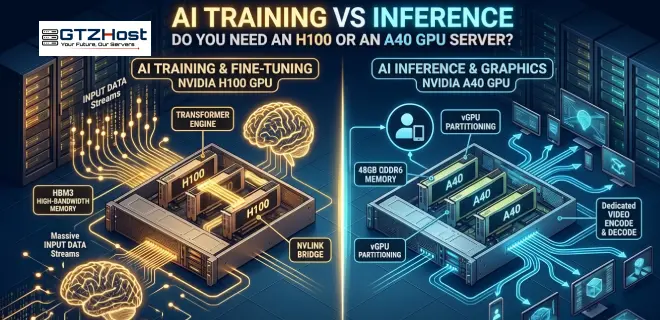
If you're training large models from scratch, fine-tuning billion-parameter LLMs, or running HPC-grade research workloads, the H100 is built for that job — its Transformer Engine and HBM3 memory bandwidth exist specifically to accelerate training at scale. If you're running inference, virtualization, rendering, video transcoding, or moderate-scale ML workloads, the A40 delivers strong performance at a significantly lower price point, often making it the smarter choice.
Training vs Inference: Why the Distinction Matters
Training builds a model from data — it's compute-intensive, memory-bandwidth-hungry, and benefits enormously from faster matrix math and larger VRAM pools, especially for large transformer architectures. This is where every architectural advantage the H100 offers actually gets used.
Inference runs an already-trained model to generate predictions. It's typically less memory-bandwidth-bound and more about steady, cost-efficient throughput — which is exactly where a GPU like the A40 shines, especially when paired with its strong virtualization and encode/decode capabilities for serving many concurrent requests.
Choosing the wrong one in either direction means either overpaying for headroom you'll never use, or under-provisioning and bottlenecking your own pipeline.
NVIDIA H100: Built for Training at Scale
GTZHost's dedicated H100 servers are available in single and dual H100 PCIe node configurations, with pricing starting around $2,699/month and scaling up based on CPU platform — from Intel Xeon Silver 4310 configurations up through dual Xeon Gold 6338/6230 and AMD EPYC 9554 builds for maximum core-count pairing.
Key H100 Features
Transformer Engine — purpose-built to accelerate the matrix operations transformer models depend on, using dynamic FP8/FP16 precision switching
HBM3 memory — significantly higher memory bandwidth than previous-generation GPUs, critical for large-batch, long-context training
NVLink Bridge Support — high-speed GPU-to-GPU interconnect for multi-GPU training jobs
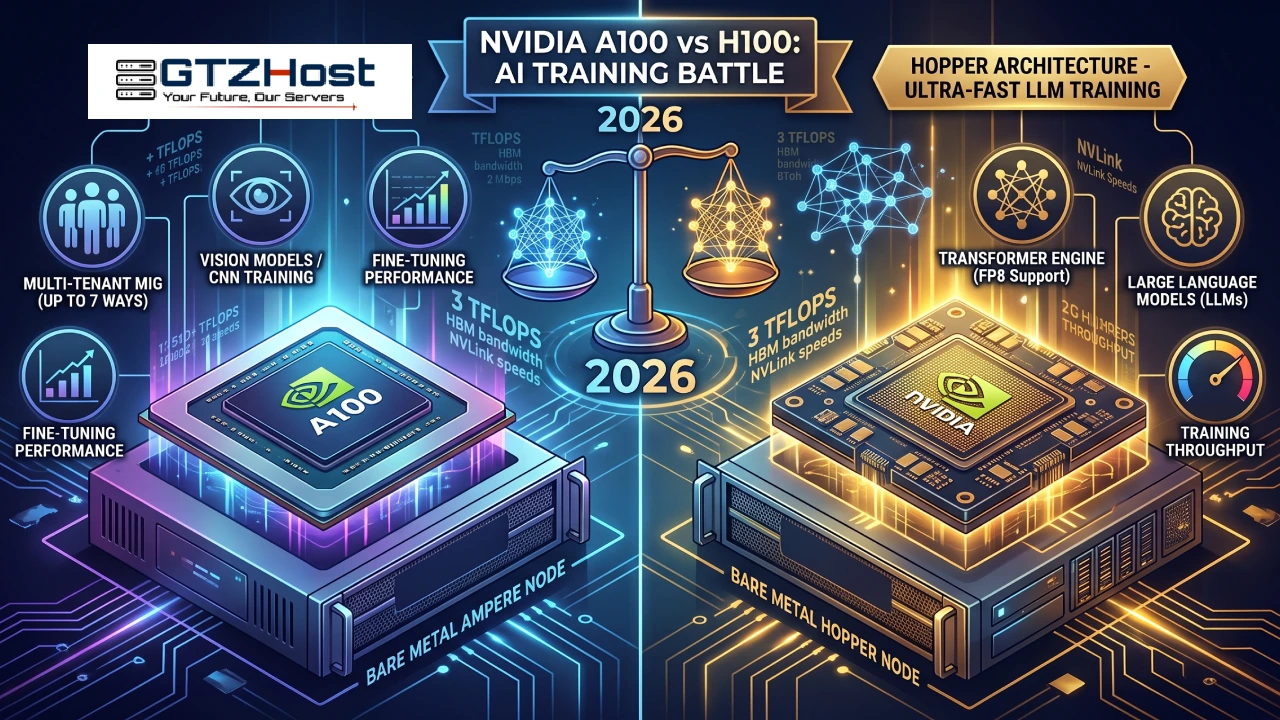
Multi-Instance GPU (MIG) — partition a single H100 into isolated instances for mixed workloads or multi-tenant research environments
Confidential Computing — hardware-level isolation for sensitive training data, relevant for healthcare, finance, and regulated industries
vGPU Instances — flexible virtualized GPU allocation for teams that need to share H100 capacity across projects
Where the H100 Makes Sense
Life sciences and drug discovery research requiring massive parallel compute
Scientific computing and HPC workloads
Financial risk modeling and economics/bioinformatics simulation
Enterprise AI agent development and training
NLP, 3D rendering, and digital twin simulation
Advanced computer vision model training
Accelerated large-scale data analytics
If your workload touches any of the above at genuine production or research scale, the H100's architecture is doing real work for you — not sitting idle.
NVIDIA A40: Versatile Power for Inference and Beyond
GTZHost's A40 dedicated servers start significantly lower — from around $999/month for entry CPU configurations, with most standard Intel Xeon Silver and Gold builds landing in the $1,350–$1,460/month range, and higher-core AMD EPYC 7543/7642 or dual Xeon Gold 6338/6248R configurations scaling up toward $3,000+/month for maximum compute pairing.
Key A40 Features
Versatile Ampere architecture — strong general-purpose performance across AI, graphics, and virtualization workloads
48GB GPU memory — ample headroom for inference serving, mid-size model fine-tuning, and memory-intensive rendering tasks
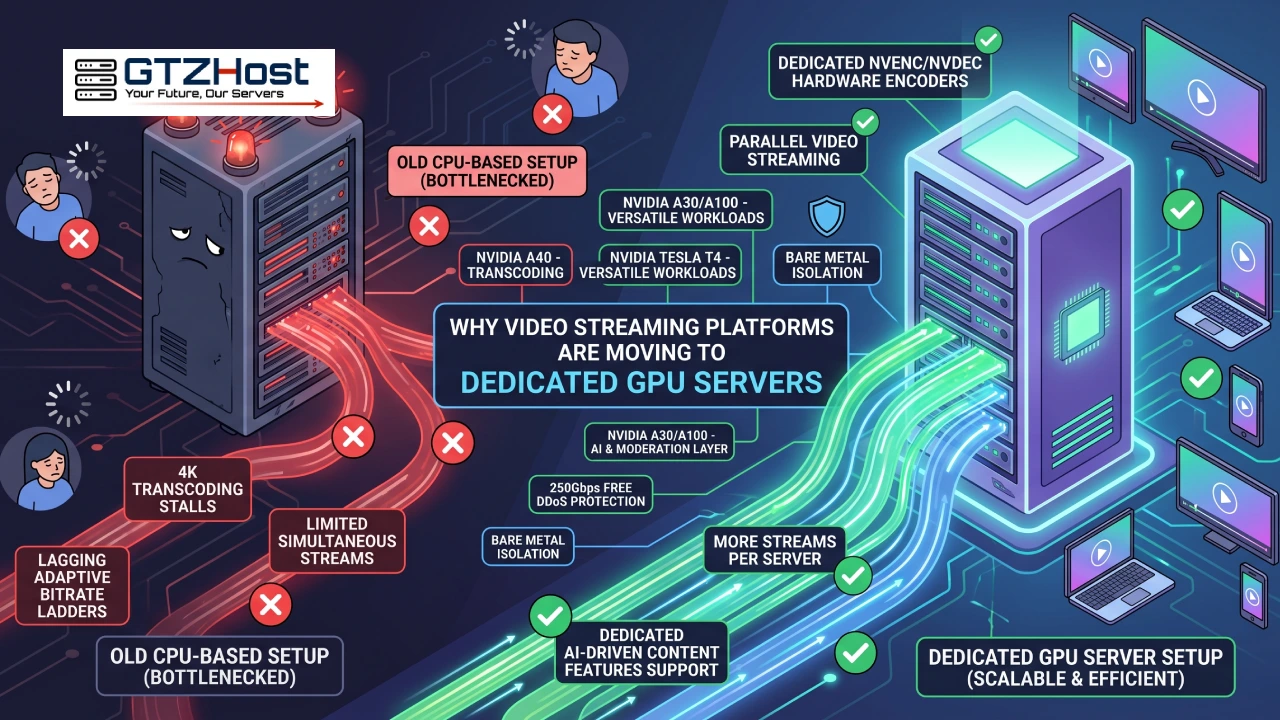
Advanced video encode & decode — dedicated hardware engines well suited to transcoding and real-time media workloads
Powerful data center virtualization — strong vGPU partitioning support for multi-tenant or shared infrastructure
Immersive VR capability — built to handle demanding graphics and virtual/augmented reality rendering workloads
Where the A40 Makes Sense
Machine learning inference and model serving at production scale
Rendering, animation, and 3D content production
High-performance computing workloads that don't require H100-class training throughput
Virtual reality and immersive graphics applications
Video transcoding and media processing pipelines
Blockchain and cryptocurrency compute
Cybersecurity workloads (threat detection, pattern analysis)
Big data analytics and visualization
H100 vs A40: Side-by-Side
| Factor | NVIDIA H100 | NVIDIA A40 |
|---|---|---|
| Best suited for | Large-scale training, LLM fine-tuning, HPC research | Inference, rendering, virtualization, transcoding |
| Architecture | Hopper | Ampere |
| GPU Memory | HBM3 (high bandwidth) | 48GB GDDR6 |
| Transformer Engine | Yes | No |
| Confidential Computing | Yes | Not specified |
| Starting price (GTZHost) | ~$2713/month | ~$999/month |
| Typical monthly range | $2,713–$3,051+ | $999–$3,098+ |
| Ideal team profile | AI research teams, large model training | ML ops, rendering studios, inference-heavy SaaS products |
Pricing reflects current GTZHost configurations at time of writing and is subject to change based on CPU platform, availability, and configuration. View live H100 pricing and live A40 pricing for current rates.
How to Decide: A Simple Framework
Ask yourself these questions in order:
Are you training a model from scratch, or fine-tuning a large (multi-billion parameter) model? → If yes, the H100's Transformer Engine and memory bandwidth will materially reduce your training time. Go H100.
Are you primarily serving an already-trained model to users (inference)? → The A40's 48GB memory and strong throughput handle most inference workloads at a fraction of the cost. Go A40.
Is your workload graphics, rendering, VR, or video-transcoding heavy rather than pure AI compute? → The A40's architecture is purpose-built for exactly this mix. Go A40.
Do you need multi-tenant GPU partitioning for a shared research or dev environment? → Both support virtualization (MIG on H100, vGPU on A40) — choose based on whether the underlying workload is training (H100) or mixed/inference (A40).
Is budget the primary constraint and your model size moderate? → Start with an A40. You can always scale to H100 capacity later as training demands grow.
Frequently Asked Questions
Can the A40 handle AI model training at all?
Yes, for small to mid-size models and fine-tuning tasks the A40 performs well. It becomes a bottleneck primarily for very large models or workloads that benefit from the H100's Transformer Engine and higher memory bandwidth.
Is the H100 overkill for inference workloads?
In most cases, yes. Inference workloads rarely need the H100's training-oriented architecture, and the cost difference is substantial — the A40 is generally the more cost-effective choice for serving already-trained models.
Why is there such a large price range within each GPU tier?
Pricing scales primarily with the paired CPU platform — configurations range from single Xeon Silver builds up to dual high-core-count Xeon Gold or AMD EPYC platforms, which affects the final monthly rate independent of the GPU itself.
Can I start with an A40 and move to H100 later?
Yes. Many teams start on A40 infrastructure for development, fine-tuning, and inference, then scale specific training workloads to H100 capacity as model size and training demands grow.
Does GTZHost offer both H100 and A40 as bare metal servers?
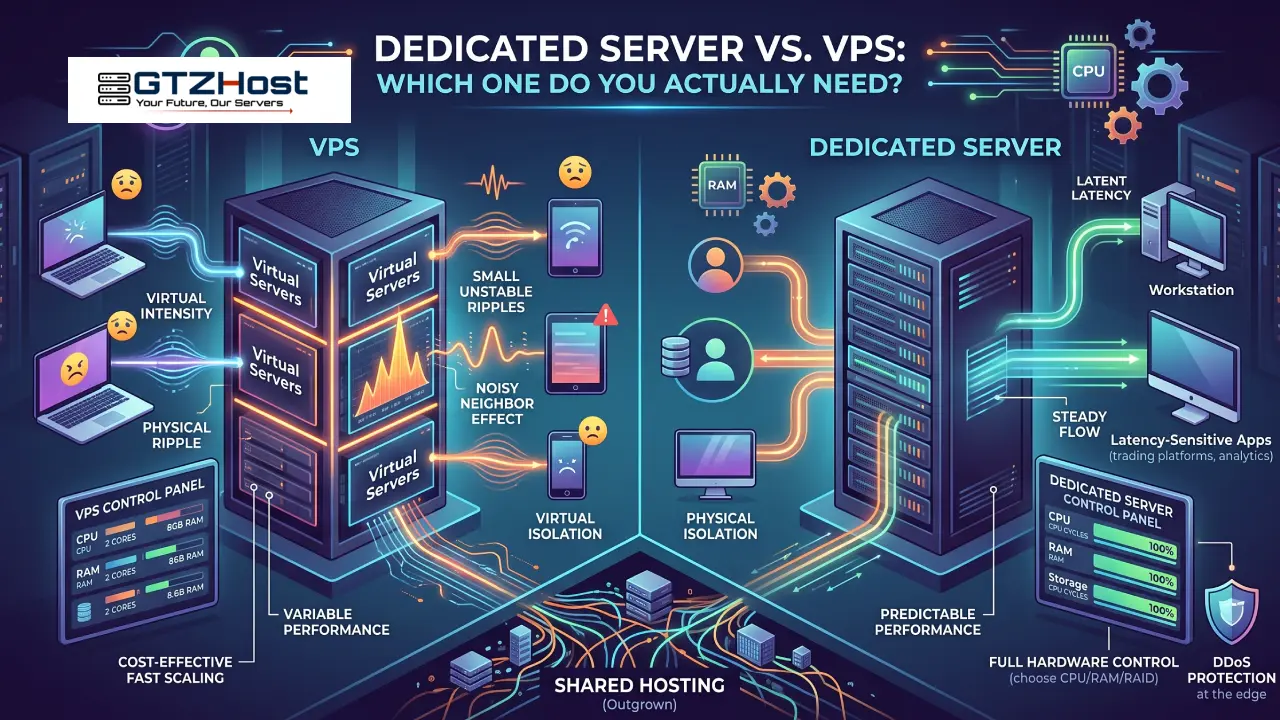
Yes. GTZHost provides dedicated H100 servers in single and dual PCIe node configurations, and A40 servers across a range of Intel Xeon and AMD EPYC CPU pairings — both deployable as bare metal with no virtualization overhead.
Final Thoughts
The H100 and A40 aren't competing for the same job — they're built for different stages of the AI lifecycle. Training large models rewards the H100's architecture every time; serving them, rendering content, or running mixed workloads is where the A40's versatility and lower cost make it the smarter infrastructure choice. Match the GPU to the workload, not the workload to whatever GPU sounds most impressive.
Ready to deploy? Compare live H100 and A40 configurations on GTZHost and size your GPU server to your actual training or inference workload.