If your website or application has outgrown shared hosting, you'll eventually land on this exact question: do you need a dedicated server or is a VPS (Virtual Private Server) enough? Both sit above shared hosting in the performance ladder, but they solve different problems — and picking the wrong one either wastes your budget or leaves your infrastructure struggling under load.
This guide breaks down the real technical and practical differences, so you can match the hosting type to what your project actually needs, not just what sounds more powerful.
What Is a VPS?
A VPS is a virtualized slice of a larger physical server. A hypervisor (like KVM or Xen) partitions one machine into multiple isolated virtual environments. Each VPS gets a fixed allocation of CPU cores, RAM, and storage, along with root or administrator access — but the underlying physical hardware is still shared among several tenants.
This gives you most of the control of a dedicated server (custom OS, full root access, your own firewall rules) at a fraction of the cost, because the physical server's cost is split across multiple customers.
What Is a Dedicated Server?
A dedicated server is a single physical machine allocated entirely to one customer. No hypervisor layer splitting resources, no other tenants competing for CPU cycles, disk I/O, or network bandwidth. Every core, every gigabyte of RAM, and every bit of storage throughput belongs to you alone.
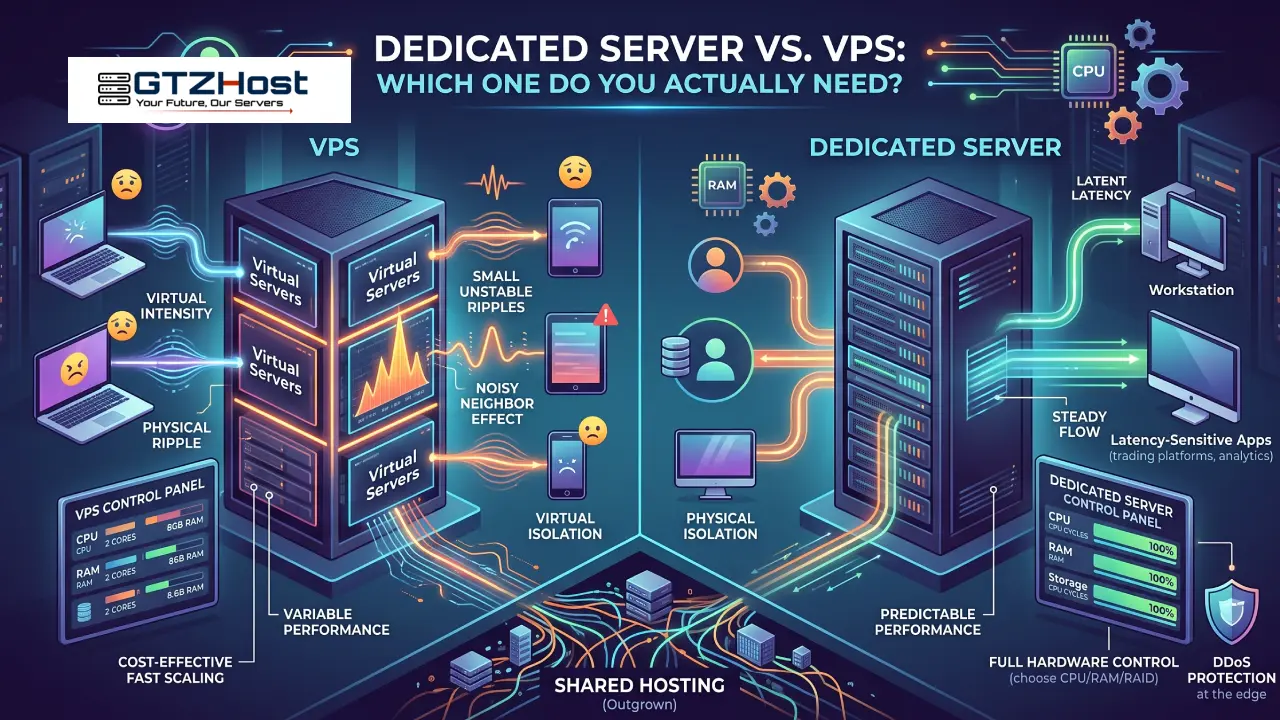
This is what removes the so-called "noisy neighbor" effect — a common VPS problem where another tenant's traffic spike or resource-heavy process quietly degrades your own server's performance, even though you didn't do anything wrong.
Key Differences That Actually Matter
1. Resource Isolation
On a VPS, your resource limits are enforced by the hypervisor, but physical components like the disk controller or network interface card are still shared infrastructure. On a dedicated server, resource isolation is physical, not virtual — there's no layer between your workload and the hardware.
2. Performance Consistency
VPS performance can fluctuate depending on how busy the host node is. A dedicated server's performance is predictable because nothing else is drawing from the same pool of CPU cycles or NVMe storage bandwidth. For latency-sensitive applications — trading platforms, real-time analytics, high-concurrency APIs — this consistency is often the deciding factor.
3. Customization and Hardware Control
With a dedicated server, you can typically choose the exact processor family (AMD EPYC vs Intel Xeon, for example), RAM configuration, RAID setup, and network port speed. A VPS gives you flexibility at the software layer, but the underlying hardware profile is fixed by the provider.
4. Security Surface
Dedicated servers have a smaller shared attack surface because there's no multi-tenant hypervisor layer to exploit. That said, a properly configured VPS with hardened firewall rules and regular patching is still secure for the vast majority of use cases. Security here is more about configuration discipline than the hosting type itself.
5. Cost
This is where VPS wins outright. You're paying for a fraction of a physical server, so pricing scales down accordingly. Dedicated servers cost more because you're renting 100% of the hardware, even during idle periods.
6. Scalability
VPS plans usually scale vertically (upgrade RAM/CPU with a few clicks) or horizontally (spin up more instances). Scaling a dedicated server means either upgrading the physical hardware — which can involve downtime — or adding another dedicated unit and load-balancing between them.
When a VPS Is the Right Call
You're running a small-to-mid traffic website, blog, or web app
Your workload has predictable, moderate resource needs
You want root access and OS-level customization without dedicated-server pricing
You're testing, staging, or building an MVP before committing to bigger infrastructure
Budget is a primary constraint and some variability in performance is acceptable
When You Actually Need a Dedicated Server
You're running high-traffic e-commerce, SaaS platforms, or database-heavy applications
You need guaranteed, unshared bandwidth — for example, unmetered connections with DDoS protection at the network edge
Compliance or security policy requires isolated physical hardware
Your workload is CPU or I/O intensive enough that "noisy neighbor" effects would be unacceptable (game servers with strict latency requirements, large-scale data processing, GPU-accelerated workloads)
You're consolidating multiple VPS instances because the overhead of managing several small servers has become more expensive — and less efficient — than one properly sized dedicated machine
A Quick Decision Framework
Ask yourself these three questions in order:
1. Does my traffic or workload fluctuate unpredictably, and would a temporary slowdown from shared hardware actually hurt my business? If yes, lean dedicated.
2. Do I need specific hardware — a particular CPU architecture, RAID configuration, or GPU — that a standard VPS tier doesn't offer? If yes, lean dedicated.
3. Is my current workload comfortably within a VPS's resource ceiling, with room to grow before I'd need to upgrade? If yes, a VPS is the more cost-efficient choice today.
There's also a middle path many teams underuse: start on a VPS, monitor real resource usage over a few months, and migrate to a dedicated server once utilization data — not guesswork — tells you it's time.
Final Take
Neither option is universally "better." A VPS is the practical choice when cost-efficiency and flexibility matter more than raw, isolated performance. A dedicated server earns its higher price tag when consistency, hardware control, and full resource isolation are non-negotiable for your workload.
If you're currently outgrowing VPS limits, look at providers offering dedicated servers with unmetered bandwidth, NVMe storage, and built-in DDoS protection — those three factors alone determine whether your migration actually solves the bottleneck or just moves it.
Explore GTZHost Dedicated Servers