gtzhost logo

NORTH AMERICA

EUROPE

ASIA

AFRICA

AUSTRALIA

SOUTH AMERICA

ARM vs x86 Server Architecture —
Choosing the Right Infrastructure

Not sure which architecture is right for your workload? While traditional x86 processors (Intel and AMD) have dominated the data center for decades, ARM architecture (like Ampere) is revolutionizing cloud computing with unprecedented efficiency and core density. Read our comprehensive guide to understand the fundamental differences between CISC and RISC architectures, and discover which silicon ecosystem perfectly matches your business needs.

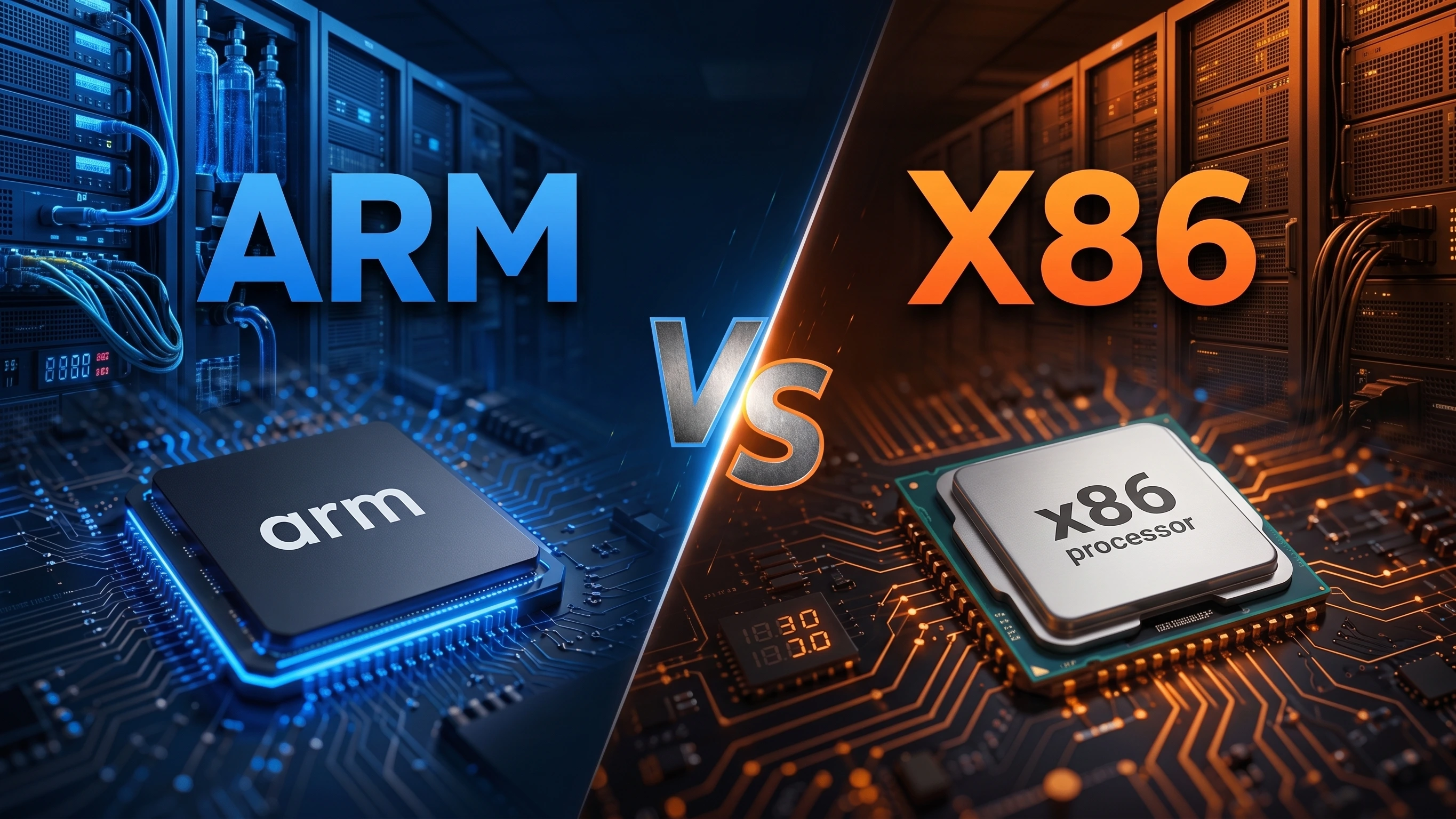
Server Architecture Comparison

The Fundamental Difference:
CISC vs RISC

The battle between x86 and ARM comes down to how the processor fundamentally understands and executes instructions.

x86 (Intel & AMD) utilizes CISC (Complex Instruction Set Computing). These processors are designed to complete complex tasks in as few lines of assembly code as possible. They are incredibly powerful, versatile, and ideal for heavy enterprise environments, but they consume more power and generate more heat.

ARM utilizes RISC (Reduced Instruction Set Computing). These processors use simple, highly optimized instructions executed in a single clock cycle. This makes ARM processors highly energy-efficient and capable of packing massive amounts of cores (up to 128) into a single chip, making them perfect for handling thousands of small, concurrent cloud-native tasks.

Workload Compatibility Guide

Matching Architecture
to Your Workload

Choosing the right silicon is about choosing the right tool for the job. Here is how they compare in real-world scenarios.

Gaming & High-Frequency Tasks

Winner: x86 (AMD Ryzen / Intel Core)
Game servers and latency-sensitive applications require massive single-thread performance and high clock speeds (GHz). x86 dominates this space effortlessly.

Docker, Kubernetes & Microservices

Winner: ARM (Ampere Altra)
Cloud-native applications scale horizontally. The massive core density and single-threaded predictability of ARM servers make them the ultimate foundation for containerized environments.

Enterprise Virtualization & Legacy Apps

Winner: x86 (AMD EPYC / Intel Xeon)
If you rely on VMware, Windows Server, legacy commercial software, or heavy monolithic databases, x86 provides the critical compatibility and deep virtualization instruction sets required.

The GTZHost Promise: Freedom of Choice

We don't force you into a single ecosystem. We provide the best hardware for every use case.

Premium AMD Infrastructure

Experience extreme multitasking with AMD EPYC and unrivaled single-core speeds with AMD Ryzen. Perfect for gaming and massive data throughput.

Enterprise Intel Infrastructure

The gold standard for stability. Intel Xeon and Intel Core processors deliver advanced hardware security and AI acceleration for mission-critical deployments.

Cloud-Native Ampere ARM

Scale efficiently with Ampere Altra processors. Experience up to 128 isolated cores designed specifically to dominate modern, containerized cloud environments.

Unified Enterprise Network

Regardless of the architecture you choose, all GTZHost bare-metal servers are backed by Gen4 NVMe storage, unmetered network ports, and free 250Gbps DDoS protection.

ARM vs x86 Architecture FAQs

Architecture FAQ
  • Is x86 architecture dead?

    No, x86 is not dead. It remains the absolute best choice for heavy enterprise virtualization, legacy software compatibility, and extreme single-core tasks like gaming. However, ARM is rapidly becoming the standard for modern, cloud-native deployments.


  • Do I need to rewrite my code to run on an ARM server?

    For interpreted languages like Python, PHP, Ruby, or JavaScript (Node.js), no code changes are required. However, if you are using compiled languages like C++ or Go, you will need to recompile your application for the ARM64 (AArch64) instruction set.


  • Can I run Windows Server on ARM?

    While Microsoft has versions of Windows for ARM, enterprise server hosting for ARM (like our Ampere servers) is optimized almost exclusively for Linux distributions (Ubuntu, Debian, AlmaLinux, Rocky Linux). If you need Windows Server, you must select our Intel or AMD x86 servers.


  • Which architecture is more cost-effective?

    ARM architecture generally offers a better performance-per-watt ratio, meaning it consumes less power and requires less cooling. This often makes ARM servers more cost-effective for high-density, multi-core workloads compared to traditional x86 servers.